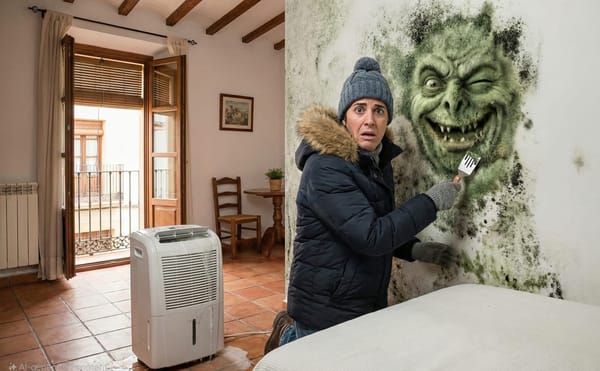
Rentals in Spain: How to Not Let Your Deposit Become a Donation 💸🇪🇸

I spend about 40% of my week on Zoom calls with clients, and 90% of that time is spent talking about one thing: Rentals.
It usually starts with: “Tash, I found this amazing place!” And ends with: “Wait, they want HOW much upfront? And what is a Fianza? Is this a scam?”
Let’s be frank: The Spanish rental market can feel like the Wild West. It’s a mix of stunning apartments, grumpy landlords, and laws that seem to change depending on which way the wind is blowing.
If you are moving here, understanding the rules isn't just "boring admin"—it is the difference between getting your money back or inadvertently funding your landlord’s next holiday.
So, grab a coffee. Let’s demystify the Fianza (and how to actually see it again).
1. The "Fianza": What is it? (And Why Do They Want My Money?)
First off, when a landlord asks for a "Fianza," it is not a scam. It is the legal rental deposit.
The Rule: By law, for a long-term rental (vivienda habitual), the landlord must take one month’s rent as a deposit. The Reality: In hot markets (hello, Madrid and Barcelona), landlords often ask for more. They call this an "Additional Guarantee" (Garantía Adicional). This can legally be up to two extra months.
So, if you are asked for 1 month Fianza + 2 months Guarantee... take a deep breath. It hurts, but it’s legal.
2. Where Does the Money Go? (The Black Hole?) 🕳️
Here is a fun fact to drop at dinner parties: The landlord isn't supposed to keep your Fianza in their personal savings account. Legally, they must deposit it with the Regional Government (e.g., the IVIMA in Madrid or INCASOL in Catalonia).
Why should you care?
- It makes it legal: If they don't deposit it, the contract might be shaky.
- Tax Breaks: In some regions, if you are under 35 or have a certain income, you can deduct rent from your taxes—but only if the deposit was registered correctly.
Tash Tip: Ask for proof that the deposit has been registered. If the landlord turns pale and starts sweating... you have your answer.
3. The "CSI: Spain" Method (How to Get Your Money Back) 🕵️♀️
Getting your deposit back in Spain is sometimes harder than getting a reservation at a Michelin-star restaurant. Landlords here are famous for trying to keep the deposit for "cleaning" or "mysterious scratches."
Your Strategy: Paranoid Documentation.
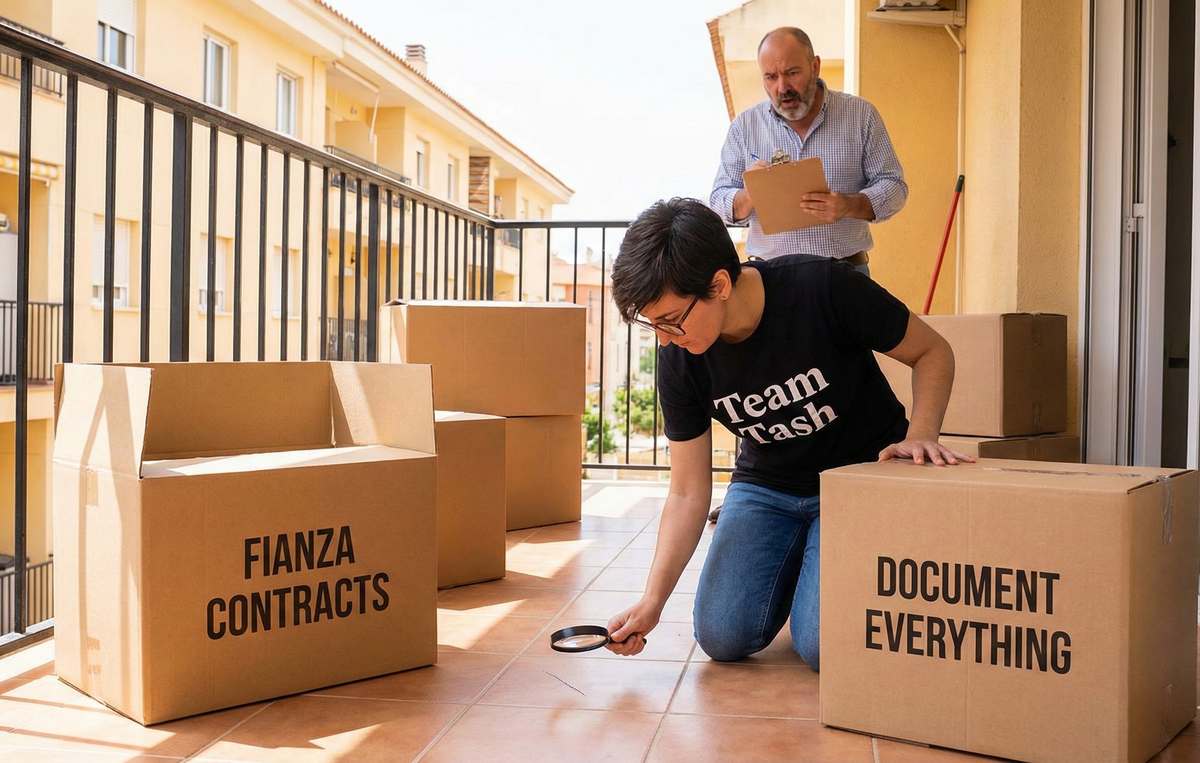
- The Day You Move In: Do not just unpack. Be forensic. Take photos of everything. The scratch on the floor? Photograph it. The chip in the mug? Photograph it. The dust on the fan? Photograph it.
- The Inventory: If the contract says there is a "New Toaster," check the toaster. If it looks like it survived a war, write that down.
- Email It: Send all these photos to the landlord/agency on Day 1. This is your timestamped proof. “Just for our records!” (Translation: “Try me.”)
4. Who Fixes What? (The Broken Boiler Dilemma) 🔧
This is the number one argument I see. The washing machine breaks. Who pays?
The General Rule:
- Small repairs (Wear and Tear): The Tenant pays. (e.g., a lightbulb blows, a door handle comes loose, you break a glass).
- Big repairs (Structural/Habitability): The Landlord pays. (e.g., the boiler dies, the fridge explodes, the roof leaks).
Tash Tip: If something breaks because it is old (not because you kicked it), the landlord pays. Stand your ground.
5. Breaking Up is Hard to Do (Ending the Contract) 💔
So, you want to leave? Spanish rental contracts (LAU contracts) are usually for 1 year, renewable up to 5 years (7 if the landlord is a company).
- The "Six Month" Rule: legally, you can usually leave after the first 6 months.
- The Notice: You generally need to give 30 days’ notice before leaving.
- The Penalty: Check your contract. Some landlords charge a penalty if you leave early (usually one month's rent for every year left on the contract).
Warning: Do not just pack up and throw the keys in the mailbox. You need to sign a "Termination Document" (Documento de Rescisión) where the landlord agrees the flat is in good condition. Without this paper, they can keep chasing you for rent!
The Final Verdict
Renting in Spain is brilliant. You get to live in cool neighborhoods, drink cheap wine on your balcony, and enjoy the Mediterranean life.
But treat it like a business transaction.
- Read the contract (or get me to read it).
- Take the photos.
- Know your rights.
You’ve got this. And if the landlord tries to charge you €200 for a "cleaning fee" when you left the place spotless? Show them the photos. 😎